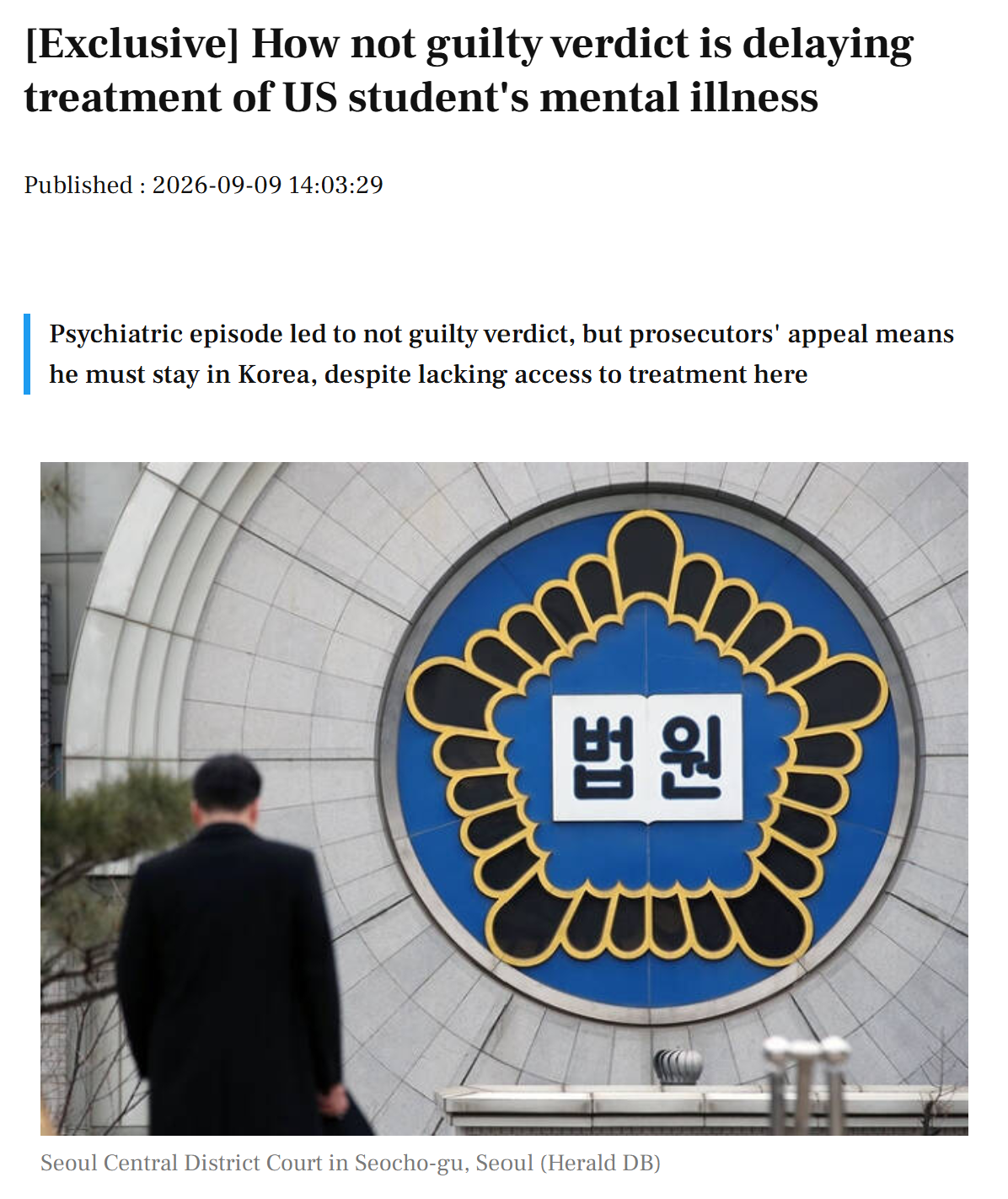
A criminal case defended by Yeohyun Yoon of SOMA Law Group (SOMA) has been reported in an exclusive by The Korea Herald. The Seoul Central District Court acquitted SOMA's client, an American exchange student, in August. The report examines why an acquitted foreign defendant remains unable to leave Korea following the prosecution's appeal, and the structural problems that arise where criminal procedure and immigration rules intersect.
The client is a US national who had completed an exchange programme at a Korean national university and was preparing to return home. In late June, days before his scheduled departure, he experienced an acute onset of psychiatric symptoms in Seoul. In that state he attempted to enter a dental clinic, took delivery parcels from inside a building, and damaged the eyeglasses of a building manager who intervened. The total loss was approximately KRW 230,000, or roughly USD 170. Prosecutors charged him with attempted trespass, theft and property damage and sought a two-month custodial sentence. The court issued a detention warrant, citing a risk of flight.
His family in the United States reported him missing to the Korean police when he failed to return on the expected date, and only through that report did they learn that he was in custody. By the time they located him, he had already spent close to a month in detention, half the sentence the prosecution had requested. Yeohyun Yoon took on the defence at this stage, secured the client's release on bail, reached a settlement with one of the two victims and deposited compensation with the court for the other.
The defence centred on establishing that, at the time of the offences, the client was suffering from an acute psychiatric episode that deprived him of the capacity to distinguish right from wrong or to control his conduct. For a foreign defendant this is not a simple exercise: medical history sits in another country, and it must be gathered and presented in a form that a Korean court can rely on. Yeohyun Yoon assembled and submitted the client's medical history, statements from his family and the circumstances surrounding the events. Applying precedent that permits a court to assess mental state from courtroom demeanour, the evidence, medical history and family background without commissioning a separate psychiatric evaluation, the Seoul Central District Court found that the client could not be held criminally responsible and acquitted him.
The prosecution has appealed, and the client cannot leave Korea until the appellate proceedings conclude. His father told The Korea Herald that his son is stranded in Korea not because he was convicted, but because he was acquitted. The client has no residence in Korea and his US health insurance does not cover the psychiatric treatment he needs here. His father has stopped working and remains in Korea to look after him.
The case illustrates that the difficulties a foreign national faces in Korean criminal proceedings are not, at their core, a matter of language. As Yeohyun Yoon explained in the report, it is unusual for a Korean national facing comparable charges to be detained, yet foreign nationals are more readily detained even in minor cases on the assumption that they lack a fixed residence and are likely to flee. A foreign defendant without family or acquaintances in Korea may be unable even to let anyone know he has been detained. Meanwhile, his immigration status can lapse without his or his family's knowledge. That is what happened here: the client's visa expired while he was in custody, and he was later fined for overstaying. Because the criminal process and the immigration system operate independently of each other, a foreign defendant can be acquitted and still suffer consequences that no one anticipated.
Yeohyun Yoon has described the case as exposing a paradox for foreign defendants. Admitting guilt, receiving a suspended sentence and being deported can be a faster route home than contesting the charges and winning. If exercising the right to plead not guilty delays a defendant's return to his own country, that right is not a complete one for a foreign national.
This is the point on which SOMA's work in criminal cases involving foreign nationals rests. SOMA is not simply a firm with "English-speaking lawyers." SOMA defends foreign clients by treating the detention review and how a foreign national is assessed at that stage, the management of the client's immigration status during custody, the involvement of family and clinicians abroad, and the steps that remain between judgment and departure as a single, connected matter from the outset. SOMA's expertise in this area comes from reading the criminal process and the immigration system together, as one whole.
The report also notes that the appeal runs against the direction of recent prosecutorial policy, which has sought to curb routine appeals against acquittals. Since June, the Supreme Prosecutors' Office has revised its internal guidelines so that appeals in cases ending in full acquittal are reviewed by an external committee, and so that appeals are declined in minor property offences where the case for pursuing a conviction is weak. SOMA continues to represent the client in the appellate proceedings, with the aim of allowing him to return home with his family and receive treatment as soon as possible.
Read the full report: The Korea Herald (9 September 2026)













The client is a US national who had completed an exchange programme at a Korean national university and was preparing to return home. In late June, days before his scheduled departure, he experienced an acute onset of psychiatric symptoms in Seoul. In that state he attempted to enter a dental clinic, took delivery parcels from inside a building, and damaged the eyeglasses of a building manager who intervened. The total loss was approximately KRW 230,000, or roughly USD 170. Prosecutors charged him with attempted trespass, theft and property damage and sought a two-month custodial sentence. The court issued a detention warrant, citing a risk of flight.
His family in the United States reported him missing to the Korean police when he failed to return on the expected date, and only through that report did they learn that he was in custody. By the time they located him, he had already spent close to a month in detention, half the sentence the prosecution had requested. Yeohyun Yoon took on the defence at this stage, secured the client's release on bail, reached a settlement with one of the two victims and deposited compensation with the court for the other.
The defence centred on establishing that, at the time of the offences, the client was suffering from an acute psychiatric episode that deprived him of the capacity to distinguish right from wrong or to control his conduct. For a foreign defendant this is not a simple exercise: medical history sits in another country, and it must be gathered and presented in a form that a Korean court can rely on. Yeohyun Yoon assembled and submitted the client's medical history, statements from his family and the circumstances surrounding the events. Applying precedent that permits a court to assess mental state from courtroom demeanour, the evidence, medical history and family background without commissioning a separate psychiatric evaluation, the Seoul Central District Court found that the client could not be held criminally responsible and acquitted him.
The prosecution has appealed, and the client cannot leave Korea until the appellate proceedings conclude. His father told The Korea Herald that his son is stranded in Korea not because he was convicted, but because he was acquitted. The client has no residence in Korea and his US health insurance does not cover the psychiatric treatment he needs here. His father has stopped working and remains in Korea to look after him.
The case illustrates that the difficulties a foreign national faces in Korean criminal proceedings are not, at their core, a matter of language. As Yeohyun Yoon explained in the report, it is unusual for a Korean national facing comparable charges to be detained, yet foreign nationals are more readily detained even in minor cases on the assumption that they lack a fixed residence and are likely to flee. A foreign defendant without family or acquaintances in Korea may be unable even to let anyone know he has been detained. Meanwhile, his immigration status can lapse without his or his family's knowledge. That is what happened here: the client's visa expired while he was in custody, and he was later fined for overstaying. Because the criminal process and the immigration system operate independently of each other, a foreign defendant can be acquitted and still suffer consequences that no one anticipated.
Yeohyun Yoon has described the case as exposing a paradox for foreign defendants. Admitting guilt, receiving a suspended sentence and being deported can be a faster route home than contesting the charges and winning. If exercising the right to plead not guilty delays a defendant's return to his own country, that right is not a complete one for a foreign national.
This is the point on which SOMA's work in criminal cases involving foreign nationals rests. SOMA is not simply a firm with "English-speaking lawyers." SOMA defends foreign clients by treating the detention review and how a foreign national is assessed at that stage, the management of the client's immigration status during custody, the involvement of family and clinicians abroad, and the steps that remain between judgment and departure as a single, connected matter from the outset. SOMA's expertise in this area comes from reading the criminal process and the immigration system together, as one whole.
The report also notes that the appeal runs against the direction of recent prosecutorial policy, which has sought to curb routine appeals against acquittals. Since June, the Supreme Prosecutors' Office has revised its internal guidelines so that appeals in cases ending in full acquittal are reviewed by an external committee, and so that appeals are declined in minor property offences where the case for pursuing a conviction is weak. SOMA continues to represent the client in the appellate proceedings, with the aim of allowing him to return home with his family and receive treatment as soon as possible.
Read the full report: The Korea Herald (9 September 2026)